Percie is a first-generation college student who attends Agnes Scott College in Decatur, Georgia. She is an Achieve Atlanta Scholar who began working with her Beyond 12 college coach, Sarah, the summer after her high school graduation from APS. Percie said that Sarah immediately became “one of the first people I call when something happens.” Sarah supported Percie by helping her hone her time management skills and manage the academic rigors of college. “I struggled with French and it was mentally and emotionally affecting me. I felt so bad and so dumb,” Percie explained. Sarah stepped in by asking her powerful questions to identify the source of her challenges and shared her own experiences of dealing with difficult classes. Ultimately, Percie was able to turn things around by working with Sarah to reframe the problem and find a tutor. Percie felt like it was affirming to have that “emotional pillar” in her coach.
When asked about only connecting with her coach through technology, Percie shares, “Sarah was able to meet me exactly where I felt comfortable - on my phone.” Percie, like many of our students, has been deeply impacted by the COVID-19 pandemic and she credits Sarah with helping her navigate the isolation of the pandemic so that she could stay on track to succeed and graduate. According to Percie, “Sarah was the one constant in my life when everything else changed so suddenly.”

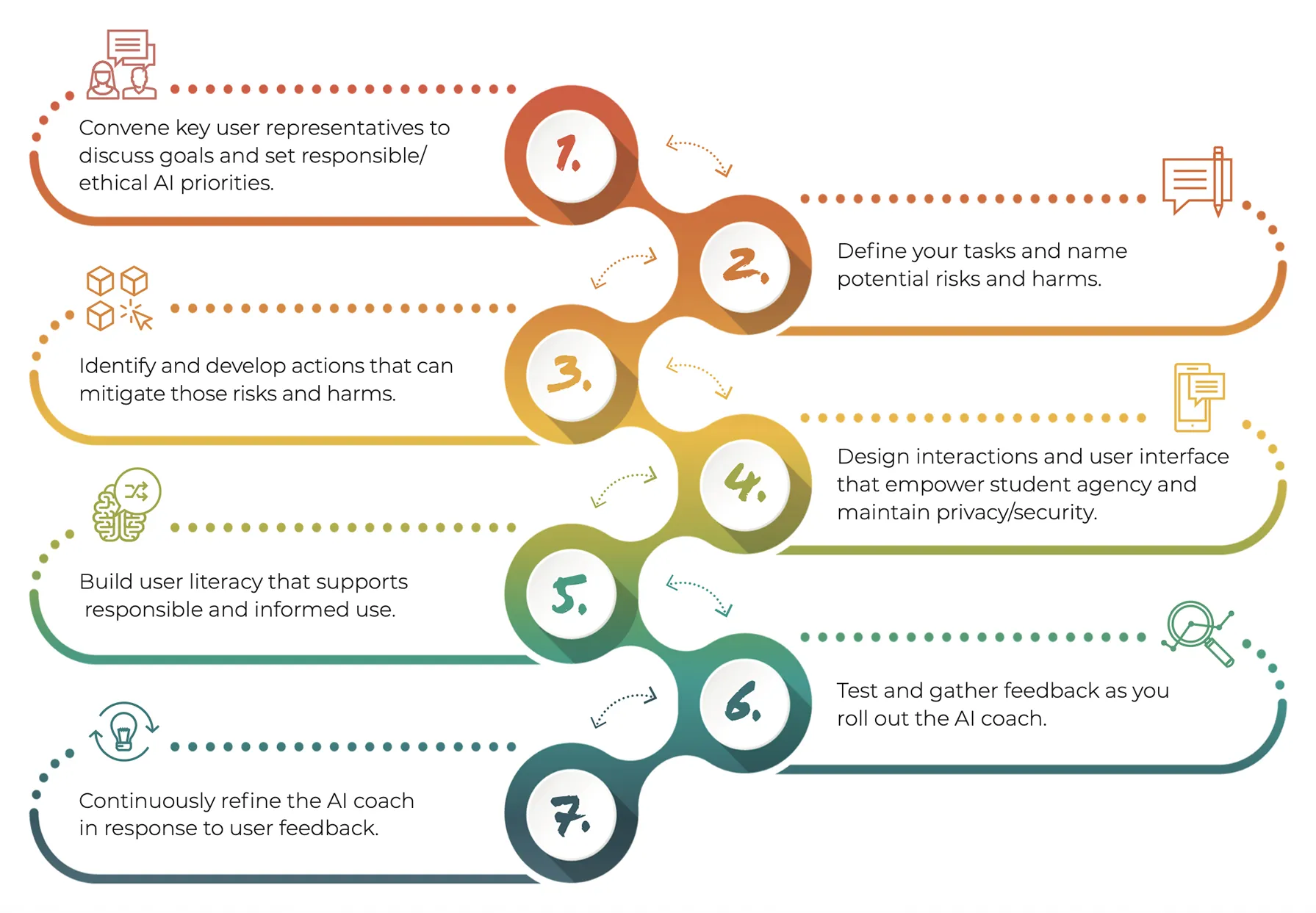
Whether you’re building or adopting GenAI, this step-by-step framework supports you in making thoughtful, ethical decisions along the way.
We help students tap into their power, graduate from college, and pursue choice-filled lives.

Creating responsible and ethical AI tools requires ongoing attention from the earliest stages of selection through development and implementation. This work must be grounded in your institution’s unique context—your students, resources, subject matter, and capacity. Whether you work in a two-year college, four-year university, or college-access program, AI tools should be responsive to the communities you serve and aligned with your goals for student success.
This framework is a clear, seven-step process, but this is not a checklist. Responsible AI work is iterative and reflective. Each step invites you to engage with users, ask key questions, and refine your approach as you go. Here’s how it works:



AI development will not slow down. Agentic AI, for example, could further enhance a coaching chatbot’s capabilities. Combining advanced AI tools with other technology, such as augmented reality, could further provide ways to empower students and coaches. AI will also evolve in ways we can’t even predict. What we can control is our commitment to upholding principles for responsible and ethical AI development.
As you and your team move forward, we invite you to revisit this framework and its interactive steps, to share with us your feedback and lessons learned, and to suggest ways we can refine and improve it.